
Compare BeO, AlN, and Alumina ceramic materials for electronic packaging. Learn their differences in thermal conductivity, electrical performance, applications, and material selection.
As electronic devices become smaller and more powerful, thermal management has become one of the most critical challenges in modern electronics.
High-power semiconductor devices, RF components, microwave systems, and power modules generate increasing amounts of heat. If this heat cannot be effectively removed, the consequences may include:
- Reduced electrical performance
- Shortened component lifetime
- Thermal failure
- Reduced system reliability
For this reason, advanced ceramic materials are widely used in electronic packaging because they provide an excellent combination of:
- Electrical insulation
- Thermal management
- Mechanical strength
- Environmental stability
Among the most commonly selected ceramic materials are:
- Beryllium Oxide (BeO) Ceramic
- Aluminum Nitride (AlN) Ceramic
- Alumina (Al₂O₃) Ceramic
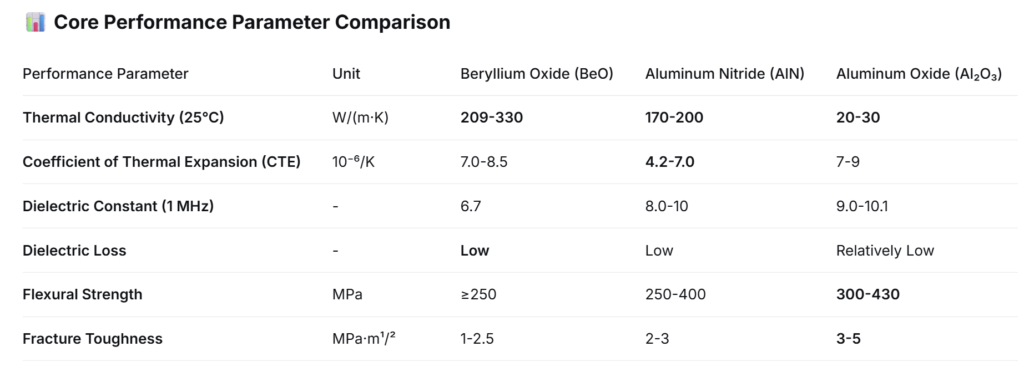
Although these materials may appear similar, their properties and applications are significantly different.
Choosing the correct ceramic material depends on:
- Thermal requirements
- Electrical performance
- Frequency range
- Mechanical conditions
- Cost considerations
- Manufacturing requirements
This article compares BeO vs AlN vs Alumina ceramic to help engineers and purchasing professionals select the right material for advanced electronic packaging applications.
Overview of Three Ceramic Materials
Beryllium Oxide (BeO) Ceramic
Beryllium Oxide ceramic is an advanced ceramic material known for its exceptional thermal conductivity while maintaining excellent electrical insulation.
Typical characteristics:
- Thermal conductivity: 250–330 W/m·K
- Excellent electrical insulation
- Low dielectric loss
- Good RF performance
- Excellent thermal expansion compatibility
Common applications:
- RF power packages
- Microwave devices
- High-power semiconductor modules
- Laser systems
- Aerospace electronics
Aluminum Nitride (AlN) Ceramic
Aluminum Nitride ceramic has gained popularity as an alternative high-performance thermal ceramic.
Advantages include:
- High thermal conductivity
- Excellent electrical insulation
- Good coefficient of thermal expansion match with silicon
Typical characteristics:
- Thermal conductivity: 140–220 W/m·K
- Low dielectric constant
- Excellent semiconductor compatibility
Common applications:
- LED substrates
- Power electronics
- IGBT modules
- Semiconductor packaging
Alumina ceramic is one of the most widely used technical ceramics due to its:
- Low cost
- High mechanical strength
- Chemical stability
- Mature manufacturing process
Typical characteristics:
- Thermal conductivity: 20–35 W/m·K
- Excellent insulation
- High hardness
- Good wear resistance
Common applications:
- Electronic substrates
- Insulators
- Ceramic packages
- Industrial components
Thermal Conductivity Comparison
Thermal conductivity is one of the most important factors in electronic packaging.
| Material | Thermal Conductivity |
| BeO Ceramic | 250–330 W/m·K |
| AlN Ceramic | 140–220 W/m·K |
| Alumina Ceramic | 20–35 W/m·K |
Why Thermal Conductivity Matters
When semiconductor devices operate at high power, heat accumulates at the junction area.
Poor heat dissipation can cause:
- Increased operating temperature
- Reduced efficiency
- Accelerated aging
- Device failure
For applications such as RF amplifiers and power modules, ceramic thermal performance directly affects product reliability.
BeO vs AlN vs Alumina: Detailed Comparison
- Thermal Performance
Winner: BeO Ceramic
BeO provides the highest thermal conductivity among these three materials.
Advantages:
- Faster heat removal
- Lower operating temperature
- Better high-power capability
Recommended for:
- RF power amplifiers
- Microwave devices
- High-power semiconductor packages
AlN Ceramic
AlN provides excellent thermal performance and is widely used in power electronics.
It is especially suitable for:
- IGBT modules
- EV power systems
- LED applications
Alumina Ceramic
Alumina offers acceptable thermal performance for low and medium power applications.
However, it may not be suitable where extreme heat dissipation is required.
- Electrical Insulation Performance
All three ceramic materials provide excellent electrical insulation.
| Property | BeO | AlN | Alumina |
| Electrical Insulation | Excellent | Excellent | Excellent |
| Dielectric Loss | Low | Low | Medium |
| High Frequency Performance | Excellent | Good | Moderate |
For RF and microwave applications, BeO generally provides better electrical characteristics.
- RF and Microwave Performance
BeO Ceramic: Excellent Choice
High-frequency applications require materials with:
- Low dielectric loss
- Stable electrical properties
- Efficient thermal management
BeO ceramic performs exceptionally well in:
- Microwave packages
- RF modules
- Radar systems
- Communication equipment
AlN Ceramic
AlN provides good RF performance but is more commonly selected for power electronics rather than extremely high-frequency RF applications.
Alumina Ceramic
Alumina is widely used in general electronic packaging but has limitations for very high-power RF systems.
- Semiconductor Packaging Applications
BeO Ceramic Applications
BeO is commonly used in:
- GaN RF devices
- LDMOS transistors
- High-power microwave modules
- Laser diode packages
Its high thermal conductivity helps maintain semiconductor reliability.
AlN Ceramic Applications
AlN is frequently selected for:
- SiC power modules
- IGBT packaging
- LED heat dissipation
- EV electronics
Its thermal expansion coefficient is close to silicon, making it attractive for semiconductor applications.
Alumina Ceramic Applications
Alumina remains popular for:
- Standard ceramic packages
- Hybrid circuits
- Sensor packages
- General electronic insulation
- Metallization Capability
For electronic packaging, ceramic materials often require metallization.
Common metallization processes:
- Mo-Mn metallization
- Tungsten metallization
- Nickel plating
- Gold plating
BeO Ceramic
Excellent metallization performance.
Used extensively in:
- Hermetic packages
- RF packages
- Ceramic-to-metal assemblies
AlN Ceramic
Requires carefully controlled metallization processes because surface chemistry differs from oxide ceramics.
Alumina Ceramic
Very mature metallization technology.
Commonly used for:
- Ceramic feedthroughs
- Vacuum packages
- Electronic housings
Material Selection Guide
Choose BeO Ceramic When:
Your application requires:
✓ Maximum thermal conductivity
✓ High-power RF operation
✓ Microwave performance
✓ Compact high-power packages
✓ Long-term reliability
Typical industries:
- Telecommunications
- Radar
- Aerospace
- Defense electronics
- Semiconductor RF
Choose AlN Ceramic When:
Your application requires:
✓ High thermal performance
✓ Semiconductor compatibility
✓ Power electronics solutions
Typical industries:
- Electric vehicles
- Renewable energy
- Power modules
- LED systems
Choose Alumina Ceramic When:
Your application requires:
✓ Cost efficiency
✓ Mechanical strength
✓ General electrical insulation
Typical industries:
- Industrial electronics
- Sensors
- General ceramic components
Why Metallized Ceramic Is Important in Electronic Packaging
Regardless of ceramic material selection, many advanced applications require metallization.
Metallized ceramic enables:
- Brazing with metals
- Hermetic sealing
- Electrical connection
- Mechanical assembly
Common applications include:
- Ceramic packages
- Vacuum feedthroughs
- RF housings
- Semiconductor modules
A reliable Metallized Ceramic Manufacturer must have experience in:
- Ceramic processing
- Surface preparation
- Metallization technology
- Brazing processes
How Engineers Select the Right Ceramic Material
Material selection should consider:
Power Density
Higher power requires better thermal conductivity.
Operating Frequency
RF applications require excellent dielectric performance.
Thermal Cycling
Repeated heating and cooling require good thermal expansion compatibility.
Manufacturing Requirements
Consider:
- Machining difficulty
- Metallization capability
- Production volume
- Cost target
Reliability Requirements
Mission-critical applications require:
- Hermetic sealing
- Stable performance
- Long service life