
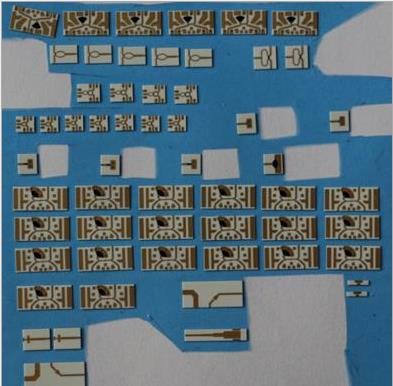
Metallized Beryllium Oxide Ceramic for High-Power RF, Microwave Vacuum Devices, Radar T/R Modules, Semiconductor Packaging.
Metallized Beryllium Oxide (BeO) ceramic combines the exceptional thermal and electrical properties of BeO with a metallized surface designed for soldering, brazing, electrical connection, and ceramic-to-metal sealing.
Coraynic Technology Limited supplies 99.5% high-purity BeO ceramic with MoMn (Molybdenum-Manganese) metallization, nickel plating, and optional gold finishing for demanding electronic, RF, microwave, power, vacuum, and high-reliability packaging applications.
BeO is particularly suitable where high thermal conductivity, electrical insulation, low dielectric loss, and dimensional stability are required. After metallization, the ceramic can be integrated with metallic components through brazing, soldering, or other joining processes, enabling the production of engineered ceramic-metal assemblies.
Our metallized BeO components can be manufactured according to customer drawings, CAD files, samples, metallization patterns, dimensional tolerances, and assembly requirements.
The result is not simply a metallized ceramic substrate, but an engineered BeO component designed for integration into a complete electronic or hermetic package.
99.5% BeO ceramic can provide thermal conductivity of approximately 285 W/m·K at 25°C, making it suitable for high-power electronic and RF applications where efficient heat dissipation is required.
BeO combines relatively low dielectric constant with low dielectric loss, supporting applications in high-frequency and microwave systems where electrical performance and thermal management must be considered together.
A controlled molybdenum-manganese (MoMn) metallization layer provides a ceramic surface suitable for subsequent nickel plating and joining processes.
Typical MoMn metallization thickness is 15–38 μm, depending on component design and technical requirements.
Nickel plating can be applied over the MoMn layer to provide a suitable surface for soldering and brazing.
Typical nickel thickness is 2–10 μm, with optional gold flash of approximately 0.05–0.3 μm where required.
Metallized BeO components can be designed for compatibility with commonly used joining systems, including Au/Sn and Ag/Cu-based brazing or soldering processes, subject to application and process qualification.
Metallized BeO can be incorporated into ceramic-to-metal assemblies requiring high vacuum tightness and hermetic sealing.
For suitable designs, air tightness can reach ≤5 × 10⁻¹² Pa·m³/s according to the specified test conditions.
Metallization can be applied to complete surfaces or selected areas according to customer drawings or CAD-defined patterns.
Available structures may include:
| Property | Unit | Typical / Specified Value |
|---|---|---|
| BeO Purity | % | 99.5 |
| Density | g/cm³ | 3.05 |
| Thermal Conductivity at 25°C | W/m·K | 310 |
| Dielectric Constant at 1 MHz | – | 6.9 ± 0.2 |
| Dielectric Constant at 10 GHz | – | 6.8 ± 0.2 |
| Dissipation Factor | – | ≤4 × 10⁻⁴ |
| CTE, 25–500°C | ×10⁻⁶/°C | 9.2 |
| Volume Resistivity at 25°C | Ω·cm | >10¹⁴ |
| Dielectric Breakdown Strength | kV/mm | ≥25 |
| Flexural Strength | MPa | ≥200 |
| Compressive Strength | MPa | >350 |
| Hardness | HRA | >86 |
| Average Grain Size | μm | 10–20 |
| Flatness | mm | <0.035 |
| Camber | ‰ | ≤2 |
| Surface Roughness | μm | Ra 0.05–0.8, customizable |
| Air Tightness | Pa·m³/s | ≤5 × 10⁻¹² |
| Metallization Parameter | Unit | Typical / Specified Value |
|---|---|---|
| Metallization System | – | MoMn |
| MoMn Layer Thickness | μm | 15–38 |
| Nickel Plating Thickness | μm | 2–10 |
| Optional Gold Flash | μm | 0.05–0.3 |
| Metallization Sintering Temperature | °C | ≤1550 |
| Multi-Layer Build-Up | – | Available |
Technical values may vary according to material formulation, component geometry, metallization pattern, processing route, and customer specifications. Final specifications should be confirmed for each project.
A typical metallized BeO component may consist of:
99.5% BeO Ceramic Substrate
↓
MoMn Metallization Layer
↓
Nickel Plating
↓
Optional Gold Flash
↓
Soldering / Brazing / Ceramic-to-Metal Assembly
This structure allows BeO to function simultaneously as a thermal management material, electrical insulator, and joining interface within an electronic package.
The metallization system and surface finish can be selected according to the customer’s assembly process, joining material, operating temperature, and reliability requirements.
Coraynic supports a wide range of metallized BeO component geometries.
Typical substrate dimensions include:
Typical thicknesses range from approximately 0.385 mm to 2.0 mm or more, depending on component design and manufacturing requirements.
Available diameters may include:
Typical thickness range: 0.25–2.0 mm.
Custom geometries can include:
Metallization geometry is an important part of the component design, particularly for RF, microwave, power electronics, and hermetic packaging.
The entire specified ceramic surface is metallized for applications requiring broad electrical or thermal interfaces.
Specific areas are metallized according to customer drawings or CAD files, allowing controlled electrical connections and joining areas.
Metallization extends from the top surface around the ceramic edge to the bottom surface where required.
Through-holes can be metallized for electrical interconnection or specific package structures.
Isolation grooves, alignment marks, and selected surface structures can be incorporated according to component requirements.
Metallized BeO is particularly suitable for high-frequency systems where thermal management, electrical insulation, dielectric performance, and package integration are important.
Typical applications include:
The combination of high thermal conductivity and electrical insulation makes BeO suitable for selected high-power semiconductor packaging applications.
Typical applications include:
Metallized BeO can be incorporated into vacuum electronic assemblies requiring electrical insulation, thermal management, and hermetic joining.
Applications include:
Metallized BeO components can be used in demanding electronic systems where low dielectric loss, thermal management, insulation, and hermetic packaging are required.
Potential applications include:
Applications may also include:
Application suitability depends on the specific component design, operating environment, regulatory requirements, and joining process.
One of the key advantages of metallized BeO is its ability to serve as an interface between ceramic and metal.
Coraynic can support ceramic-to-metal assemblies using suitable metals and joining technologies, including:
Joining methods may include:
The appropriate joining system depends on ceramic grade, metal selection, coefficient of thermal expansion, joint geometry, operating temperature, filler metal, mechanical requirements, and required hermeticity.
Coraynic’s BeO manufacturing and metallization capabilities cover the major stages from ceramic processing to finished metallized components.
For suitable designs, manufacturing capabilities include:
Quality control can cover both the BeO substrate and metallization system.
Depending on project requirements, inspection may include:
For hermetic components, leak testing can be performed using helium leak detection according to the agreed technical specification.
Material certificates and inspection documentation can be provided according to customer requirements.
Coraynic supports OEM and customized metallized BeO components based on:
Our engineering team can assist with:
For new projects, customers are encouraged to provide the drawing, ceramic grade, dimensions, metallization area, metal counterpart, joining method, operating temperature, and required hermeticity where available.
Coraynic combines several capabilities that are normally sourced from different suppliers:
BeO Ceramic Manufacturing
→ Precision Processing
→ MoMn Metallization
→ Nickel / Gold Plating
→ Ceramic-to-Metal Brazing & Sealing
→ Inspection & Hermeticity Testing
This integrated approach allows customers to develop a metallized BeO component as an engineered assembly rather than a standalone ceramic substrate.
Our focus is on customized components for applications where thermal performance, electrical insulation, RF performance, metallization reliability, and hermetic sealing are all important.
Beryllium oxide ceramics are intended for professional and industrial applications. Finished, properly processed BeO components are different from loose BeO powders or dust-generating materials; however, machining, grinding, drilling, or other operations that may generate airborne BeO particles require appropriate engineering controls and occupational safety procedures.
Customers should follow applicable local regulations and the relevant Safety Data Sheet (SDS) for BeO materials and processing operations.
Coraynic can provide safety documentation for professional users upon request.
Looking for a metallized BeO substrate, RF ceramic component, hermetic BeO feedthrough, or custom BeO ceramic-to-metal assembly?
Send us your technical drawing, sample, metallization pattern, material requirements, dimensions, joining method, or application specifications.
Our engineering team can review your requirements and recommend a suitable BeO grade, MoMn metallization system, plating structure, and ceramic-to-metal joining solution.
Contact Coraynic Technology Limited for a quotation and technical discussion.